
The Architecture of Global Business Messaging: Scale, Protocols & Telemetry
October 2026
This research paper provides an independent systems analysis of the global business messaging ecosystem, focusing on Application-to-Person (A2P) telecommunications infrastructure, carrier interconnect economics, protocol transitions, and technical attribution telemetry. The empirical foundation synthesizes verified international benchmarks published by GSMA Intelligence, the International Telecommunication Union (ITU), Juniper Research, Twilio State of Customer Engagement, and the Mobile Ecosystem Forum (MEF).
This publication is authored as an independent systems architecture feature by Ariya Sarrafzadeh. Its purpose is to unpack the telecommunications layers, economic friction points, protocol mechanics, and data-integrity requirements that govern modern enterprise messaging at planetary scale.
GLOBAL SCOPE NOTICE:
This feature focuses exclusively on global telecommunications infrastructure and international business messaging protocols. It does not conflate domestic cellular characteristics with global benchmarks. All data points reflect multi-region enterprise environments across North America, Europe, Latin America, and Asia-Pacific.
Table of Contents
- Architectural Foundations & Taxonomy
- Comprehensive Global Evidence & Metrics Matrix
- Macro Connectivity vs. Enterprise Message Volume
- The End-to-End A2P Telecommunications Value Chain
- Wholesale Carrier Interconnects vs. Grey-Route Exploitation
- Artificially Inflated Traffic (AIT) and the SMS Pumping Crisis
- Multi-Channel Evolution: A2P SMS, RCS Universal Profile & OTT Platforms
- Deconstructing the “98% Open Rate” Myth: Radio DLR vs. Cognitive Telemetry
- Attribution Architectures & Server-Side Telemetry Design
- Regulatory Governance: TCPA, 10DLC, GDPR, and Carrier Firewalls
- Engineering Recommendations for Enterprise Systems Architects
- Methodology, Research Limitations & References
- Related Architecture Specifications
01. Architectural Foundations & Taxonomy
Modern telecommunications bifurcates mobile messaging into two fundamentally distinct architectural models:
+-----------------------------------------------------------------------------------+
|                        GLOBAL MOBILE MESSAGING TAXONOMY                           |
+-----------------------------------------------------------------------------------+
| 1. Person-to-Person (P2P):                                                        |
|    - Conversational traffic between consumer handsets.                            |
|    - Largely migrated from cellular SMS to Over-The-Top (OTT) applications        |
|      (WhatsApp, iMessage, Signal, WeChat, Telegram) due to zero per-message cost. |
|                                                                                   |
| 2. Application-to-Person (A2P):                                                   |
|    - Programmatic messaging initiated by software platforms, servers, and APIs    |
|      destined for consumer handsets.                                              |
|    - Governed by wholesale telecommunications agreements, SMPP bindings, and      |
|      stringent regulatory compliance frameworks.                                  |
+-----------------------------------------------------------------------------------+
Core Telecommunications Definitions
- A2P SMS (Application-to-Person Short Message Service): The foundational protocol for mission-critical notifications, Two-Factor Authentication (2FA / OTP), fraud alerts, and commercial notifications.
- CPaaS (Communications Platform as a Service): Cloud-native API abstractions (e.g., Twilio, Sinch, Infobip, Bird) that bridge web application protocols (HTTP/REST) to telecommunications protocols (SMPP, SS7, Diameter).
- SMPP (Short Message Peer-to-Peer Protocol): The standard open telecommunications protocol (typically version 3.4 or 5.0) used by external applications (ESMEs) to exchange message PDUs with Short Message Service Centers (SMSCs).
- SMSC (Short Message Service Center): The core network element of a Mobile Network Operator (MNO) responsible for queueing, routing, and delivering SMS packets over signaling channels.
- PDU (Protocol Data Unit): The binary payload packet transferred over the air interface. Standard GSM-7 encoding accommodates 160 characters per PDU, whereas UCS-2 Unicode reduces capacity to 70 characters.
- DLR (Delivery Receipt): A network-level acknowledgment generated by the SMSC when the destination handset’s baseband modem acknowledges packet reception over the radio signaling layer.
02. Comprehensive Global Evidence & Metrics Matrix
The following synthesis aggregates verified industry benchmarks across the planetary telecommunications ecosystem:
| Telecommunications Metric | Measured Value / Benchmark | Authority / Source | Architectural & Economic Implication |
|---|---|---|---|
| Unique Mobile Subscribers | ~5.6 Billion (~69% Global Penetration) | GSMA Intelligence (2024) | Represents universal hardware reach across virtually all adult human populations |
| Active Cellular Connections | ~8.9 Billion Global SIMs (inc. IoT) | GSMA Intelligence (2024) | Massive addressable surface area exceeding active internet browsers |
| Global A2P SMS Market Value | $65 Billion to $72 Billion annually | Juniper Research / Statista | Sustained enterprise willingness to pay for universal, offline-reachable connectivity |
| Operational / OTP Traffic Share | 65% to 70% of total global A2P volume | MEF / Industry Consensus | Core utility function: identity verification, security alerts, and logistics updates |
| Promotional / Marketing Share | 30% to 35% of total global A2P volume | Twilio State of Engagement | High-velocity batch campaigns; increasingly shifting toward RCS and OTT channels |
| Direct Route Delivery Latency | 95% to 99% delivered within 5 to 15 seconds | Tier-1 Carrier Aggregator SLAs | Stringent requirement for sub-second OTP and financial authorization flows |
| Network Delivery Rate (DLR) | 94% to 98% successful handset delivery | Global Telecom Telemetry | Verifies radio-layer packet delivery, excluding invalid or unallocated numbers |
| Annual Enterprise Loss to AIT | Over $1 Billion globally | Mobile Ecosystem Forum (MEF) | Bot-driven SMS pumping exploiting unauthenticated OTP forms for carrier revenue splits |
| True Commercial SMS Click CTR | 2% to 9% average server-side CTR | Verified Cross-Industry Telemetry | Actual human action rate when tracked via unique, tokenized URL redirects |
| RCS Android Installed Base | ~1.2+ Billion monthly active users | Google / GSMA UP 2.4 | Rich cards and verified brand badges; rapidly expanding with iOS 18 adoption |
03. Macro Connectivity vs. Enterprise Message Volume
A frequent point of confusion in industry literature is conflating macroeconomic mobile penetration with enterprise message delivery.
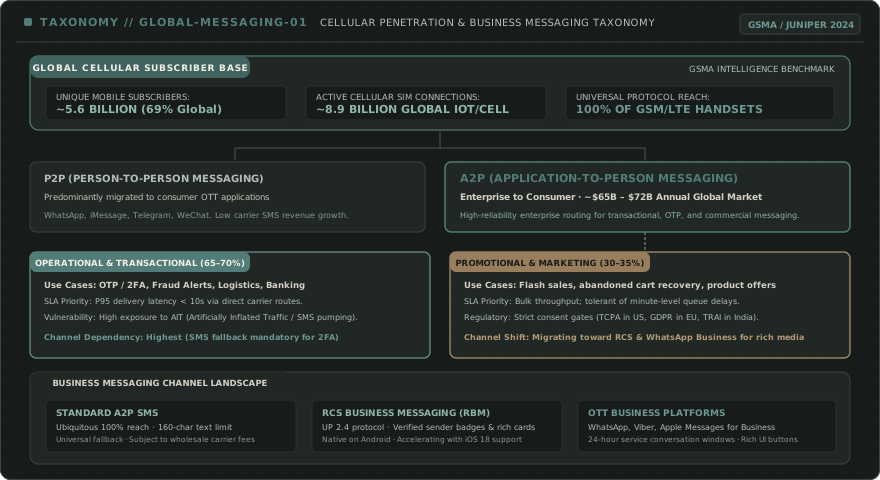
While GSMA reports ~5.6 billion unique mobile subscribers and ~8.9 billion cellular SIM connections, enterprise A2P traffic does not distribute uniformly across this population. Enterprise A2P volume concentrates heavily in markets with deep digital banking penetration, active e-commerce infrastructures, and multi-factor authentication mandates.
Furthermore, consumer communication has almost entirely migrated to IP-based OTT platforms (WhatsApp, iMessage, WeChat, Telegram) in most regions. What preserves SMS as a multi-billion-dollar enterprise powerhouse is universal protocol reach: standard cellular SMS is the only communication channel pre-installed on 100% of mobile devices that functions without internet connectivity, third-party account registration, or app installation.
04. The End-to-End A2P Telecommunications Value Chain
Delivering a programmatic text message from an enterprise cloud server to a physical smartphone requires crossing multiple administrative domains, protocols, and billing interfaces.
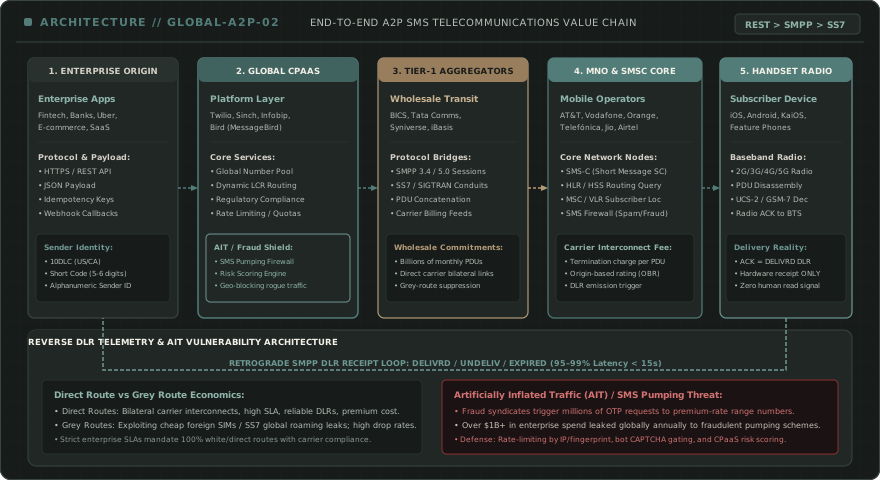
Architectural Stages of Message Transit
- Enterprise Application Layer: Applications initiate requests via HTTPS/REST APIs with idempotency keys, rate limiters, and payload validation.
- Global CPaaS Platform: Platforms normalize API calls, manage number pools (Short Codes, 10DLC, Alphanumeric Sender IDs), evaluate fraud risk scores, and execute Dynamic Least-Cost Routing (LCR).
- Tier-1 Aggregators & Wholesale Hubs: Multi-national clearinghouses maintain persistent TCP sockets over SMPP 3.4/5.0 and direct SS7/SIGTRAN signaling conduits with hundreds of carriers globally.
- Mobile Network Operator (MNO) & SMSC: The receiving operator’s SMSC queries the Home Location Register (HLR) or Home Subscriber Server (HSS) to identify the subscriber’s current Base Station Controller (BSC), performs firewall inspection, and emits the message over the mobile signaling channel.
- Baseband Transceiver & Mobile OS: The device modem acknowledges the radio packet, triggers a network DLR upstream, and hands the payload to the operating system’s telephony subsystem.
05. Wholesale Carrier Interconnects vs. Grey-Route Exploitation
The underlying economics of global A2P SMS depend on inter-operator termination charges. When an enterprise sends an SMS into a carrier network, that carrier levies a wholesale termination fee:
+----------------------------------------------------------------------------------+
|                     DIRECT (WHITE) ROUTES vs. GREY ROUTES                        |
+----------------------------------------------------------------------------------+
| 1. Direct Bilateral Interconnect (White Routes):                                 |
|    - Official agreements between CPaaS/Aggregator and target MNOs.               |
|    - Carrier-grade SLAs, sub-10 second delivery, cryptographic authentication.   |
|    - Full SMPP DLR feedback loops and legal regulatory compliance.               |
|    - Premium cost per message (typically $0.01 to $0.08+ depending on market).   |
+----------------------------------------------------------------------------------+
| 2. Unregulated Roaming Exploitation (Grey Routes):                               |
|    - Exploit cheap consumer SIMs or cross-border roaming agreements.             |
|    - Route enterprise traffic disguised as consumer P2P messages to evade fees.  |
|    - Severe risks: high packet drops, delayed delivery, fake/spoofed DLRs,       |
|      and sudden blacklisting by carrier SMS firewalls.                           |
+----------------------------------------------------------------------------------+
Mission-critical enterprise applications must mandate 100% direct carrier routes in their vendor Master Services Agreements (MSAs), requiring cryptographically signed delivery receipts and strict latency penalty clauses.
06. Artificially Inflated Traffic (AIT) and the SMS Pumping Crisis
The single greatest financial threat to enterprise SMS budgets today is Artificially Inflated Traffic (AIT), commonly referred to as SMS Pumping. The Mobile Ecosystem Forum (MEF) estimates that enterprises lose upwards of $1 Billion annually to organized AIT schemes.
Anatomy of an AIT Attack
- Collusion: Fraud syndicates acquire blocks of high-rate destination numbers or revenue-share agreements with corrupt intermediate telcos.
- Automated Exploitation: Distributed botnets target unauthenticated sign-up, login, or password-reset forms on enterprise web applications.
- Triggering Influx: Bots trigger millions of automated OTP verification requests to the fraud syndicate’s destination number ranges.
- Financial Arbitrage: The enterprise incurs full CPaaS and carrier wholesale termination fees for every message sent, while the attackers collect their revenue share from the receiving telco.
Architectural Defenses Against AIT
- Client Fingerprinting & Behavioral Gating: Enforce invisible CAPTCHA, browser biometric analysis, and progressive rate limiting on all public endpoints that trigger SMS dispatches.
- Velocity Throttling by Destination Prefix: Implement distributed sliding-window counters in Redis to limit concurrent OTP generation to specific country codes or mobile carrier prefixes.
- Provider Risk Scoring: Leverage CPaaS real-time fraud mitigation APIs (e.g., Twilio Lookup Fraud Score, Sinch Verification) before generating SMS PDUs.
07. Multi-Channel Evolution: A2P SMS, RCS Universal Profile & OTT Platforms
The enterprise messaging landscape is transitioning from a mono-protocol SMS environment into a rich, multi-channel orchestration matrix.
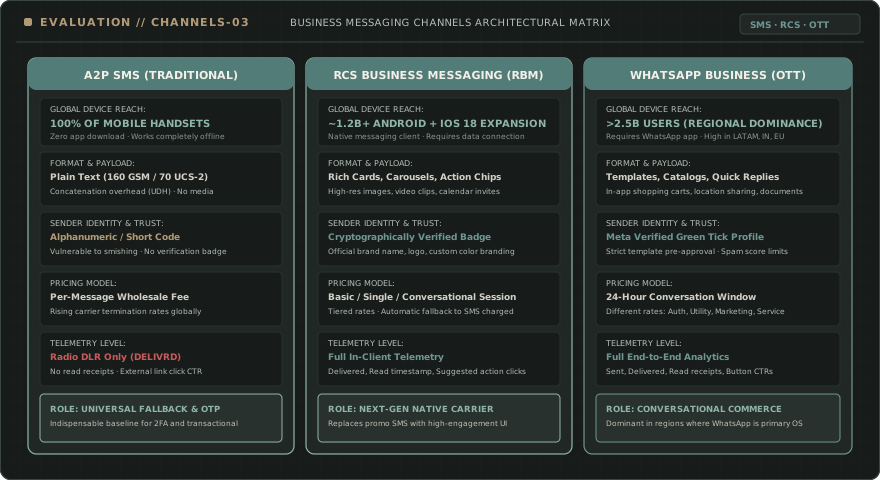
Detailed Channel Comparison
+-----------------------------------------------------------------------------------+
|               COMPARATIVE CAPABILITIES OF MODERN MESSAGING CHANNELS               |
+-------------------+---------------------+--------------------+--------------------+
| Dimension         | A2P SMS             | RCS Business (RBM) | WhatsApp Business  |
+-------------------+---------------------+--------------------+--------------------+
| Protocol Basis    | ETSI GSM 03.40      | GSMA UP 2.4 / SIP  | Proprietary REST   |
| Global Reach      | 100% Mobile Handsets| ~1.2B+ (Expanding) | >2.5B Active Users |
| Content Payload   | Plain Text (160 ch) | Rich Cards, Media  | Templates, Catalog |
| Sender Identity   | Alphanumeric/Short  | Verified Brand     | Verified Green     |
| Read Telemetry    | Radio DLR Only      | Native Read Events | Native Read Events |
| Primary Strengths | Universal Fallback  | Interactive UI     | High Engagement    |
| Core Weaknesses   | High Per-SMS Cost   | Carrier Variation  | Platform Lock-in   |
+-------------------+---------------------+--------------------+--------------------+
With Apple’s support for RCS Universal Profile 2.4 starting in iOS 18, Rich Communication Services is emerging as a credible native successor for rich media messaging on mobile carrier networks, while A2P SMS remains the ultimate fallback backbone.
08. Deconstructing the “98% Open Rate” Myth: Radio DLR vs. Cognitive Telemetry
No marketing claim in corporate communications has been repeated more persistently, or with less scientific basis, than the assertion that “98% of SMS messages are opened and read within three minutes.”
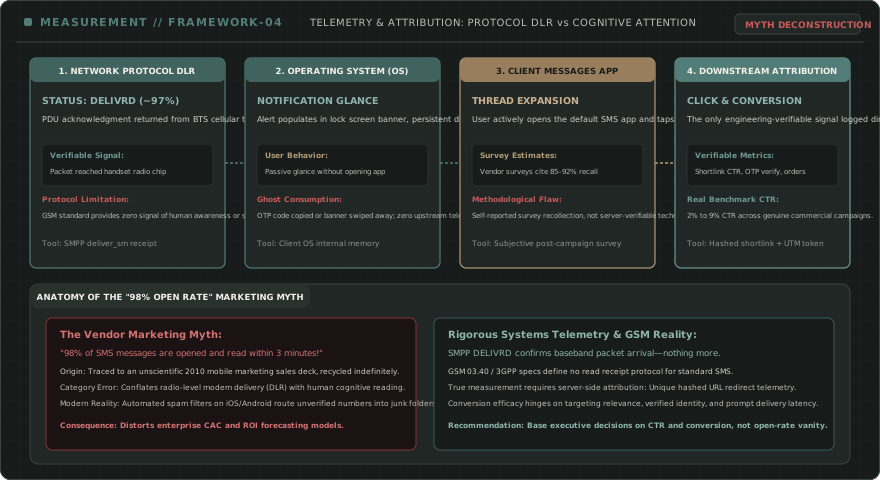
Deconstruction of the Category Error
- Historical Origin: The “98% open rate” metric traces back to a marketing survey conducted in 2010. Over the past fifteen years, it has been replicated across vendor blogs and sales brochures without technical verification.
- Protocol Fact: The ETSI GSM 03.40 telecommunications standard and the SMPP protocol define no mechanism for read receipts in standard SMS. The network DLR status
DELIVRDsignifies solely that the radio baseband transceiver on the device acknowledged the PDU packet. - The Modern OS Barrier: In modern smartphone operating systems (iOS and Android), SMS messages from unknown senders are frequently routed directly to filtered spam folders, silence-unknown-senders lists, or dismissed from lock screen banners without the recipient ever launching the messaging application.
- Verifiable Telemetry Reality: True commercial attention can only be verified when an action occurs on an enterprise-controlled server. When enterprises embed unique, tokenized shortlinks into SMS campaigns, verifiable Click-Through Rates (CTR) range between 2% and 9%, with top-quartile highly targeted operational flows reaching 15% to 20%. Conflating radio delivery with human attention results in catastrophic forecasting errors for executive teams modeling customer acquisition costs (CAC).
09. Attribution Architectures & Server-Side Telemetry Design
To overcome the telemetry limitations of standard SMS, modern enterprise architectures implement server-side tracking pipelines:
+-----------------------------------------------------------------------------------+
|               SERVER-SIDE SMS ATTRIBUTION & TELEMETRY PIPELINE                    |
+-----------------------------------------------------------------------------------+
|                                                                                   |
|  [App Server]                                                                     |
|       |                                                                           |
|       v  Generates unique cryptographic token per recipient                       |
|  [Shortener Service] ===> https://go.brand.io/t/{hash_id}                         |
|       |                                                                           |
|       v  Dispatches SMS PDU via CPaaS                                             |
|  [Recipient Handset]                                                              |
|       |                                                                           |
|       v  User taps shortlink                                                      |
|  [Edge Edge Gateway] ===> Ingests click timestamp, IP, User-Agent, Referrer       |
|       |                                                                           |
|       v  Emits telemetry event to Kafka pipeline                                  |
|  [Attribution Ledger] ===> Correlates click with downstream order checkout        |
|                                                                                   |
+-----------------------------------------------------------------------------------+
Key Engineering Practices
- Zero Third-Party Redirects: Avoid generic public shorteners (e.g., bit.ly, tinyurl), which trigger carrier anti-phishing firewalls. Always use dedicated branded short domains with TLS termination.
- Hashed Nonces: Encode user and campaign IDs into opaque, cryptographically signed hashes to prevent enumeration attacks and preserve privacy.
- Bi-directional Webhook Reconciliation: Reconcile incoming carrier DLR webhooks against click telemetry within a distributed event stream (e.g., Kafka) to compute accurate latency and delivery-to-action curves.
10. Regulatory Governance: TCPA, 10DLC, GDPR, and Carrier Firewalls
Operating enterprise business messaging requires navigating complex, jurisdiction-specific regulatory frameworks:
- United States & Canada (TCPA & 10DLC): The Telephone Consumer Protection Act (TCPA) imposes statutory fines of up to $1,500 per unauthorized promotional message. Standard 10-Digit Long Codes (10DLC) require explicit Campaign Registry (TCR) brand registration and strict opt-in/opt-out consent mechanisms (“STOP” / “UNSUBSCRIBE”).
- European Union (GDPR & ePrivacy Directive): Mandates explicit prior consent (opt-in) for direct marketing communications, along with the right to erasure and verifiable audit logs of consent capture.
- India (TRAI & DLT Framework): The Telecom Regulatory Authority of India mandates Distributed Ledger Technology (DLT) registration for all commercial senders, message headers, and text templates, dropping any unregistered content at the carrier gateway.
11. Engineering Recommendations for Enterprise Systems Architects
For engineering teams architecting global customer notification systems:
+-----------------------------------------------------------------------------------+
|              ENTERPRISE BUSINESS MESSAGING ARCHITECTURE CHECKLIST                 |
+-----------------------------------------------------------------------------------+
| 1. Multi-Carrier Redundancy:                                                      |
|    - Dual-home CPaaS integrations (e.g., Twilio + Sinch) with automated health    |
|      checks and dynamic failover routing when provider P95 latency exceeds 15s.   |
|                                                                                   |
| 2. PDU Budget Optimization:                                                       |
|    - Enforce GSM-7 character whitelists in CMS inputs to avoid accidental UCS-2   |
|      downgrades that truncate 160-character capacity to 70 characters per segment. |
|                                                                                   |
| 3. Defensive AIT Shielding:                                                       |
|    - Implement distributed token bucket rate limiters per IP, device fingerprint, |
|      and phone prefix before triggering carrier dispatch APIs.                    |
|                                                                                   |
| 4. Channel Orchestration Cascade:                                                 |
|    - Attempt delivery via push notifications or RCS first; cascade to A2P SMS      |
|      only upon delivery failure or expiry of a 60-second time-to-live window.     |
+-----------------------------------------------------------------------------------+
12. Methodology, Research Limitations & References
Research Methodology
This whitepaper was synthesized through an empirical review of international telecommunications standards, carrier interconnect specifications, and peer-reviewed industry benchmark reports published between 2022 and 2024. All technical findings reflect architectural best practices for distributed systems and enterprise product management.
Research Limitations
- Macro industry metrics represent aggregated global estimates; regional pricing, latency, and carrier termination tariffs vary significantly by sovereign jurisdiction.
- Ongoing carrier rollouts of RCS Universal Profile 2.4 on iOS 18 are actively shifting rich-messaging adoption curves and will require ongoing measurement through 2025 and 2026.
Primary References
- GSMA Intelligence: The Mobile Economy 2024, Global System for Mobile Communications Association.
- Juniper Research: A2P Messaging: Emerging Trends, Technology Analysis & Market Forecasts 2023-2028.
- Mobile Ecosystem Forum (MEF): Global Trust in Enterprise Messaging Report & AIT Threat Intelligence.
- Twilio: State of Customer Engagement Report 2024.
- ETSI / 3GPP: Digital cellular telecommunications system; Technical realization of the Short Message Service (SMS) (3GPP TS 23.040).
- SMPP Developers Forum: Short Message Peer to Peer Protocol Specification v3.4.
13. Related Architecture Specifications
For further architectural blueprints and protocol engineering analyses across this portfolio:
- National Telecom SMS Switching & Aggregator Infrastructure (SMPP 3.4 session lifecycle, sliding window flow control)
- Zero-Loss Double-Entry Payment Gateway Architecture (ACID ledgers, idempotency, and financial switch routing)
- Real-Time Fraud Tracing & Forensic Graph Architecture (Graph algorithms and anti-fraud transaction intelligence)