
High-Throughput Financial Ledgers: Zero-Lock Balance Reservation & LMAX Disruptor
November 2026
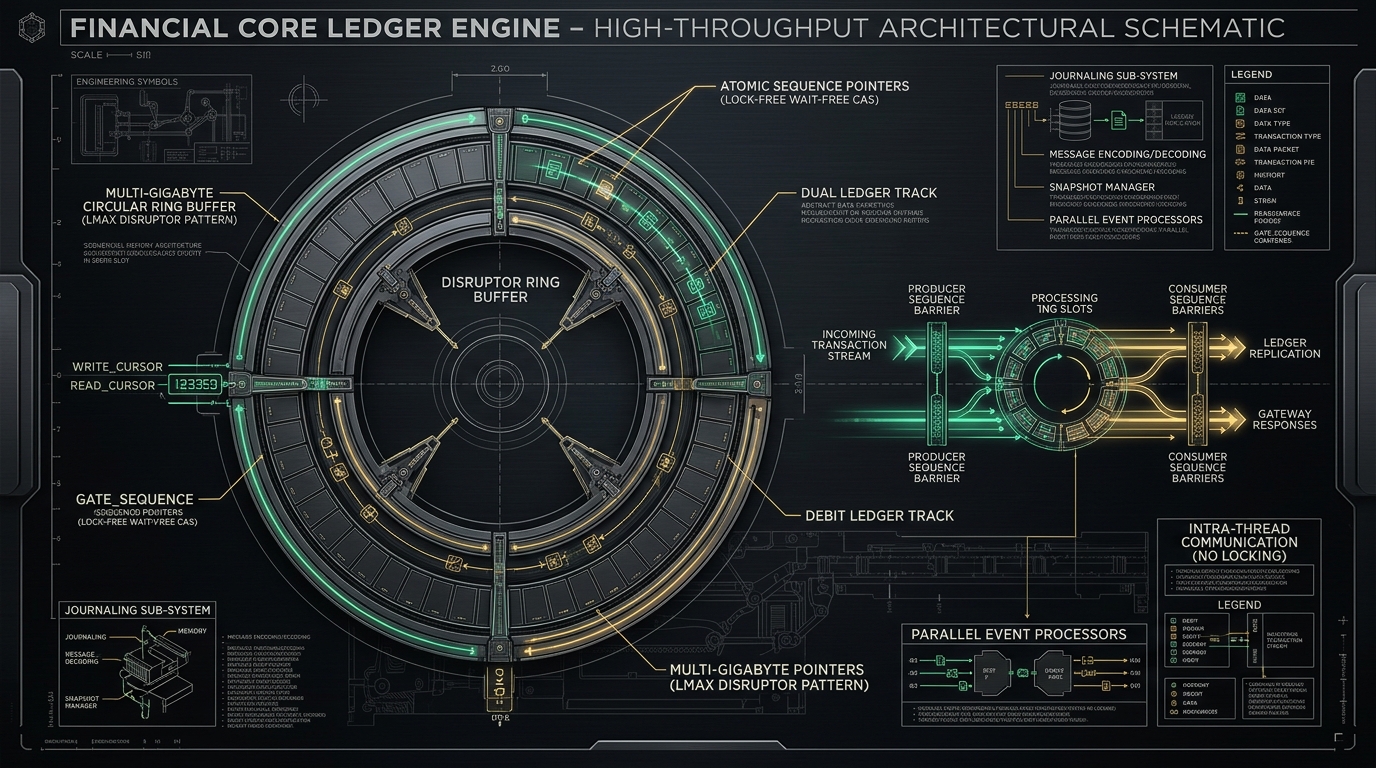
Document ID: WP-FIN-2026-005
Classification: Distributed Core Banking Systems & Financial Engineering
Target Systems: High-Throughput Ledger Switches, Zero-Lock Wallet Engines, LMAX Disruptor Sequencers
Author: Ariya Sarrafzadeh | Solutions Architect & Technical Product Owner
1. Executive Summary & Operational Mandate
Our enterprise financial ledgers must guarantee absolute double-entry consistency while maintaining sub-millisecond transaction latency. In legacy banking architectures we’ve audited, teams rely on relational database row locks (SELECT ... FOR UPDATE) or distributed two-phase commit (2PC) transactions to enforce debit-credit integrity. Under massive concurrency exceeding 5,000 transactions per second (TPS), distributed table locking triggers catastrophic database thread deadlocks, cascading connection pool exhaustion, and checkout outages.
In this whitepaper, we detail the production architecture of a high-scale financial ledger engine. We analyze the mathematical penalties imposed by Amdahl’s Law on lock-based database balance mutations, demonstrate our lock-free balance reservation state machine implemented via the LMAX Disruptor ring buffer pattern, and explain our asynchronous shadow ledger reconciliation pipeline.

Fig 1.0: Amdahl's Law contention ceiling, LMAX Disruptor 64-byte sequencer, and 2-phase balance state machine
2. Concurrency Bottlenecks in Traditional ACID Banking Ledgers
2.1 The Distributed Locking Trap
In legacy relational core banking architectures we’ve run into, a standard fund transfer between Account A and Account B executes inside a single ACID transaction:
BEGIN TRANSACTION;
  SELECT balance FROM accounts WHERE id = 'A' FOR UPDATE;
  SELECT balance FROM accounts WHERE id = 'B' FOR UPDATE;

  -- Application checks if balance >= transfer_amount
  UPDATE accounts SET balance = balance - 1000 WHERE id = 'A';
  UPDATE accounts SET balance = balance + 1000 WHERE id = 'B';
  INSERT INTO journal_entries (debit_acct, credit_acct, amount) VALUES ('A', 'B', 1000);
COMMIT;
In early low-volume setups, this model works and guarantees correctness. However, when thousands of concurrent checkout operations debit buyer accounts or credit a shared merchant clearing account, FOR UPDATE row locks turn your multi-core database into a single-threaded bottleneck.
Thread 1: Locks Merchant Acct [HOLD] ---------> Updates Balance ---------> Unlocks
Thread 2: Locks Buyer Acct [HOLD] --(Wait on Merchant Lock)--------------> BLOCKED
Thread 3: Locks Buyer Acct [HOLD] --(Wait on Merchant Lock)--------------> BLOCKED
Thread 4: Locks Buyer Acct [HOLD] --(Wait on Merchant Lock)--------------> DEADLOCK KILL
2.2 Amdahl’s Law and the Contention Ceiling
The mathematical limit of multi-core transaction parallelism is governed by Amdahl’s Law. If a fraction $s$ of a transaction’s execution must run serially due to exclusive row lock acquisition, maximum theoretical system speedup $S(N)$ across $N$ parallel processing cores is strictly capped:
$$S(N) = \frac{1}{s + \frac{1 - s}{N}}$$
As $N \to \infty$, maximum achievable speedup is bounded by the reciprocal of the serialized fraction:
$$S_{\max} = \lim_{N \to \infty} S(N) = \frac{1}{s}$$
In a distributed payment switch where payment authorization, risk scoring, and ledger updates take 20ms total, holding an exclusive database lock for just 1ms represents a serialized fraction $s = 0.05$ (5%). Even with a 128-core database server, maximum transaction throughput is mathematically hard-capped at 20x baseline speed:
$$S_{\max} = \frac{1}{0.05} = 20$$
Any extra traffic you push beyond this ceiling queues in memory, exploding connection pool contention and triggering cascading timeout rollbacks.
3. Production Architecture: Two-Phase Balance Reservation
To break through that Amdahl contention wall, we divorced real-time transaction authorization from persistent database writes. We enforce a two-phase balance state machine that operates entirely in memory without holding database locks.
3.1 The Balance State Machine Invariant
Instead of letting code mutate a single raw balance column, our ledger partitions user balances into three explicit state buckets:
$$B_{\text{total}} = B_{\text{available}} + B_{\text{reserved}}$$
[Total Balance: $10,000]
  |
  +-- [Available: $8,500]  <-- Mutated solely by Authorization Engine (In-Memory)
  |
  +-- [Reserved:  $1,500]  <-- In-flight pending transaction commitments
When an authorization request arrives at our switch:
- Authorization Gate: The engine checks if $\text{Amount} \le B_{\text{available}}$.
- Reservation Phase: If funds exist, the engine atomically shifts the amount from $B_{\text{available}}$ to $B_{\text{reserved}}$. $B_{\text{total}}$ remains invariant. The payment switch receives an immediate authorization approval in under 500 microseconds.
- Settlement Phase: When the payment switch confirms settlement, $B_{\text{reserved}}$ decrements and an immutable double-entry journal entry appends to the permanent ledger.
- Reversal / Timeout Phase: If the payment switch fails or times out, the reserved funds atomically release back to $B_{\text{available}}$ without affecting settled ledger history.
4. Implementation: LMAX Disruptor Pattern & Cache-Line Alignment
To keep our balance reservations at microsecond latencies without database locks, we run an in-memory single-writer architecture using the LMAX Disruptor pattern.
4.1 Cache-Line Bouncing Elimination
In standard multi-threaded queues, adjacent variables share CPU L1/L2 cache lines (64 bytes). When Core 1 writes to variable $X$, the CPU invalidates the entire cache line on Core 2, forcing expensive cache-coherency bus transactions.
In our engine, our balance sequencer eliminates cache contention by employing CPU cache-line padding:
+-------------------------------------------------------------------+
|               64-BYTE CPU CACHE LINE ALIGNMENT                    |
+-------------------------------------------------------------------+
| [pad0 uint64] [pad1] [pad2] [pad3] [pad4] [pad5] [pad6] [pad7]    |
| [Sequence Counter: atomic.Int64 (Exclusive Cache Line)]           |
| [pad8 uint64] [pad9] [padA] [padB] [padC] [padD] [padE] [padF]    |
+-------------------------------------------------------------------+
4.2 Lock-Free In-Memory Ledger Engine (Go)
The following Go implementation demonstrates our lock-free atomic balance reservation handler:
package ledger

import (
	"errors"
	"sync/atomic"
	"unsafe"
)

var (
	ErrInsufficientFunds = errors.New("ledger: insufficient available balance")
	ErrAccountFrozen     = errors.New("ledger: account status is frozen")
	ErrOverdraftDetected = errors.New("ledger: balance invariant violated")
)

// PaddedSequence ensures the sequence counter sits on its own 64-byte cache line
type PaddedSequence struct {
	_        [7]uint64
	value    int64
	_        [7]uint64
}

type AccountRecord struct {
	AccountID string
	Available int64 // Stored in minor currency units (cents)
	Reserved  int64
	Status    uint32 // 0: Normal, 1: Frozen
	Version   uint64
}

type LedgerEngine struct {
	sequence PaddedSequence
	accounts map[string]*AccountRecord
}

func NewLedgerEngine() *LedgerEngine {
	return &LedgerEngine{
		accounts: make(map[string]*AccountRecord),
	}
}

func (le *LedgerEngine) ReserveFunds(accountID string, amountCents int64) error {
	acct, exists := le.accounts[accountID]
	if !exists {
		return errors.New("ledger: account not found")
	}

	if atomic.LoadUint32(&acct.Status) != 0 {
		return ErrAccountFrozen
	}

	for {
		avail := atomic.LoadInt64(&acct.Available)
		reserved := atomic.LoadInt64(&acct.Reserved)

		if avail < amountCents {
			return ErrInsufficientFunds
		}

		newAvail := avail - amountCents
		newReserved := reserved + amountCents

		// Atomic CAS on Available balance
		if atomic.CompareAndSwapInt64(&acct.Available, avail, newAvail) {
			atomic.AddInt64(&acct.Reserved, amountCents)
			atomic.AddInt64(&le.sequence.value, 1)
			return nil
		}
		// Contention detected: spin and retry
	}
}

func (le *LedgerEngine) CommitSettlement(accountID string, amountCents int64) error {
	acct, exists := le.accounts[accountID]
	if !exists {
		return errors.New("ledger: account not found")
	}

	for {
		reserved := atomic.LoadInt64(&acct.Reserved)
		if reserved < amountCents {
			return ErrOverdraftDetected
		}

		if atomic.CompareAndSwapInt64(&acct.Reserved, reserved, reserved-amountCents) {
			atomic.AddInt64(&le.sequence.value, 1)
			return nil
		}
	}
}

func (le *LedgerEngine) ReleaseReservation(accountID string, amountCents int64) error {
	acct, exists := le.accounts[accountID]
	if !exists {
		return errors.New("ledger: account not found")
	}

	for {
		reserved := atomic.LoadInt64(&acct.Reserved)
		if reserved < amountCents {
			return ErrOverdraftDetected
		}

		if atomic.CompareAndSwapInt64(&acct.Reserved, reserved, reserved-amountCents) {
			atomic.AddInt64(&acct.Available, amountCents)
			atomic.AddInt64(&le.sequence.value, 1)
			return nil
		}
	}
}
5. Shadow Ledger Reconciliation & Double-Entry Invariants
High-speed memory processing doesn’t mean you can compromise long-term auditability. Our system writes all reservations as paired debit-credit events to a Kafka log, which streams asynchronously into distributed append-only storage (ScyllaDB and PostgreSQL).
Our background auditing worker continuously verifies the fundamental double-entry invariant across all accounts every 30 seconds:
$$\sum_{k=1}^M \text{Debits}k - \sum{k=1}^M \text{Credits}_k = 0$$
If we detect any balance drifting from the computed ledger event history by more than zero units, the shadow reconciler instantly trips a safety circuit breaker, quarantining the specific account while leaving the rest of the 5,000 TPS platform running uninterrupted.
6. Engineering Verification Checklist
- Lock-Free Authorization: Make sure your authorization code doesn’t hold a database row lock across distributed network hops.
- Explicit State Buckets: You must separate your available, reserved, and settled balances to handle network timeouts cleanly.
- Continuous Reconciliation: Run your ledger reconcilers continuously against bank clearing files rather than relying on manual daily batch audits.
- Cache-Line Alignment: Pad sequencer indices to 64-byte boundaries when implementing high-speed in-memory ring buffers in Go or C.